
AI Case Study; Dallas Industrial Park
Generating a 27 × 85 Foot Day|Night Backing from Client Supplied Plates
March 2026
Production Dilemma & Solution
In the beginning of March we were contacted by a new series to produce a 27 x 85 foot day|night backing of a site specific Dallas Industrial Park for delivery by the first week of April. With a week needed for shipping & delivery, this gave us three weeks for production. That, plus budget constraints and location logistics, would not allow for travel and custom photography by ourselves.
As a solution, we relied on daytime location photography by the art director, using her plates and our sky catalog to first create a daytime panorama, then using a combination of conventional techniques and AI tools to create the final night panorama for print.
Creative Process
Daytime Image
While on location, the art director captured a series of overlapping iPhone images covering the entire view. Although shooting handheld with your phone is not the most ideal method, having a significant amount of overlap from one image to the next will greatly help to reduce stitching errors in post, which was the case here. After receiving the images, we first merged them using panoramic software to create our starting point.

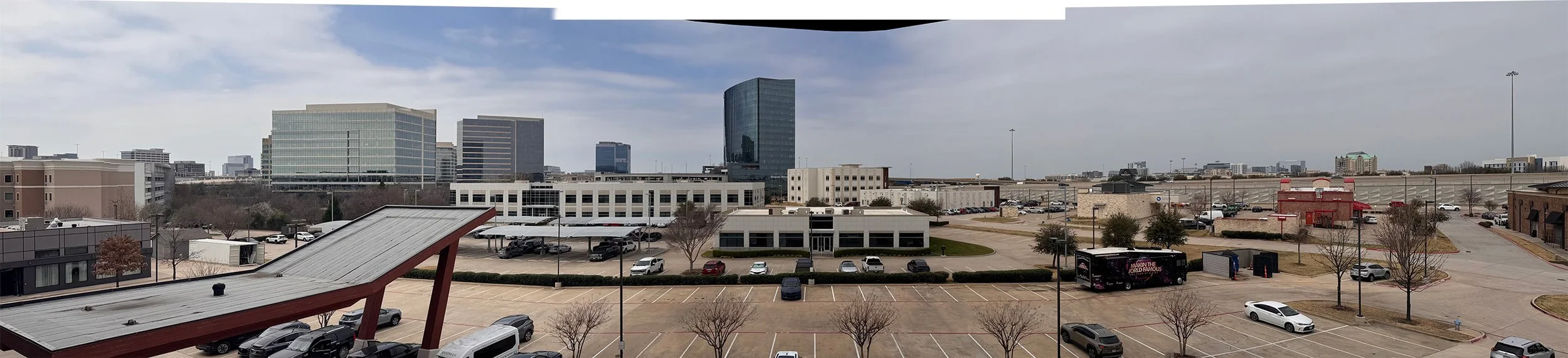
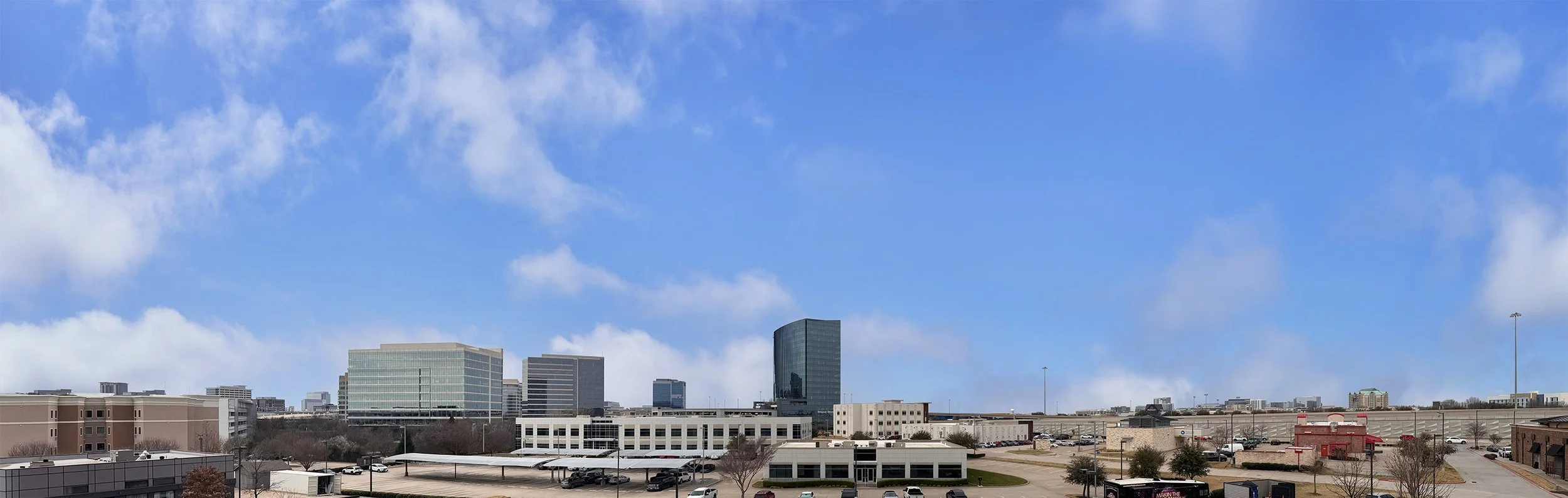
After identifying the position of the horizon line, we made our final crop based upon set design. This removed a decent amount of the bottom but tripled the height of the image creating a large void on top. To fix this, we dropped in a new sky from our catalog taking guidance from the art director and DP on the selection. Likewise, to help push the scale back a bit, an additional 5 foot sliver was generated in post by book-ending the left edge. Last, the encroachment of the porte cochere (left of center) was edited out of the image.
Nighttime Image
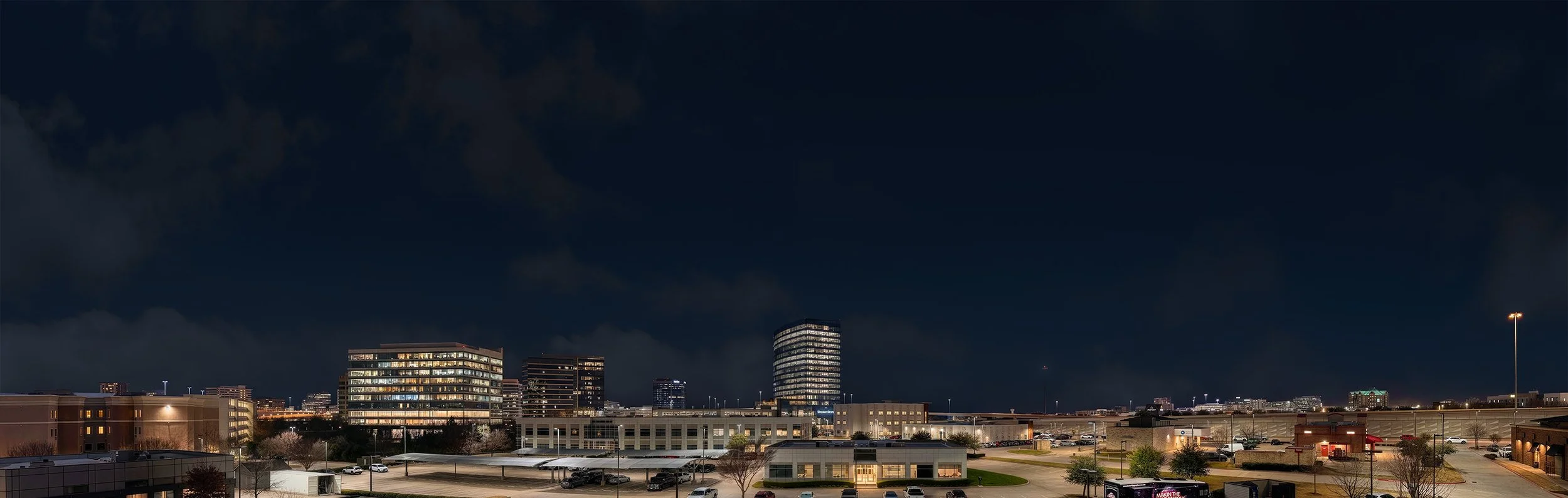
With the blessing of the art director, we then proceeded to use a combination of conventional methods with new AI tools to generate the night view.
Our first step was to crop out as much of the sky as we could without loosing any architectural information. Outputs in AI are limited in resolution and decreasing the height of the image as much as possible would allow us to work within this limitation. Plus, the sky in the night needs to match the day and it is fairly easy to edit the sky to appear as night.

Next, a series of overlapping plates were created from the this thinner panorama and processed through Adobe Firefly. This is not as straight forward as it sounds and one has to pay close attention to the prompts used not only for creative reasons but also issues regarding registration. After upscaling the outputs to match resolution, we layered and aligned them onto our thinner panorama before blending them together with masks and layer adjustments.

After taking our blended AI night plates and dropping them into the master file with the full height, we then moved onto using conventional methods to finalize the image. Our first step was to overlay the daytime sky and edit it to appear as night. Afterwards, we created a generic night from day conversion using a variety of LUTs, adjustment layers and hand painted light scallops before blending our AI night atop. Both of these not only eliminated the disjointed feel of the image but also helped set us up for the next phase.
Given the need for a perfect registration, we now scoured over the night image ensuring there were no mismatches from day to night. From a global perspective, AI can be quite good at creating a matching night version, however, at the micro level, slight differences can exist. We have found this commonly happens with text; occasionally the AI engine can not identify the exact font used and may replace it with a slightly different one. This was the case with the logo & lettering on the trailer (right of center) and a couple of the building signs. Also, in the distance, small changes occurred such as replacing a far off office building with a parking garage or reading roof vents as windows. Although, we suspect the lack of resolution and sharpness in this image probably added to these misinterpretations. Last, on the highway, AI kept adding in light streaks from cars no matter how many times we told it not to. All of this needed to be corrected for print, which we did by taking cuts from the daytime image and blending them into the night.
Although this is a tedious job, bare in mind we would have to do this anyway even with a custom day|night backing we captured ourselves. Over the course of a day, vehicles move and are swapped, leaves and branches change position, and light streaks from cars are hard to not capture at night. This may, or may not, be a little more involved with an AI Night, but the time saved from conventionally hand painting the night version is far greater.
To finalize for print, as with all backdrops, we first added a blur to help create the illusion of depth on stage. Since this backing was created from iPhone images, the blur was not as intense as with our captures, but one was stilled needed. Likewise, additional layers were added to compensate for CMYK conversions and the propensity for backings to wash out when backlit.
Copyright and Clean Chain of Title
As exciting as AI appears to be, there are warranted concerns about AI created content infringing upon already copyrighted material and/or being impossible to copyright itself. Given we are starting with an actual photograph captured by someone with the production and using AI to help us generate a derivative work with little to no change in composition, this backing would not be infringing upon other intellectual property. Furthermore, there are little to no physical alterations of objects within the derivative work along with human editing required to assemble the final night image. All this creates a clean chain of title that points back to the us and the production. Also, keep in mind when using a day|night backing, regardless of how that backing is lit, you are always recording the daytime image with the nighttime image acting as a glorified color/luma filter.