
Case Study; Dallas Industrial Park
Generating a 27 × 85 Foot Day|Night Backing from Client Supplied Images
March 2026
Production Dilemma & Solution
In the first week of March we were contacted by a Production that needed a 27 x 85 foot day|night backing of a site specific Dallas Industrial Park for delivery by the first week of April. With a week needed for shipping & delivery, this gave us three weeks for production. That, plus budget constraints and location logistics, would not allow for any custom photography by ourselves.
As a solution, we relied on daytime location photography by the art director, using her plates to first create a daytime panorama, then dropped in a new sky from our catalog (allowing for proper horizon line placement), and use a combination of older school editing techniques and AI to create the final night panorama for print.
Artistic Vision
As is the case with all creative processes, when using AI it is best to pre-visualize what you intend to create and then determine the means required to achieve that creation. Haphazardly generating imagery without starting points and clear direction is what produces slop in any medium, AI being no different.
Taking inspiration from Stephen H. Burum when lighting Prague, we asked ourselves if we had an unlimited lighting budget and weeks to work with, how would we light this scene at night? This image was captured in the early morning just after sunrise, but prior to the sunlight making its way into the alleyways, allowing for a long enough exposure to see into the first floor retail stores. More then likely, given the age of these buildings, those retail stores would be illuminated with fluorescent lamps, something that appears evident in the image. Enhancing this would make sense. Likewise, we can assume the above story apartments and the lobby on the right would be lit using some kind of warm tone light.
The early morning light added a slight gradient coming towards us in the alleyway on the left. Working with this, it would be easy to imagine having a daylight LED streetlamp just out of view producing a more intense gradient of light up the street. Likewise, this blue light, along with having the light above the retail transom daylight balanced too, would add a great source of color contrast with the fluorescent and incandescent lights of the interiors. The holiday lights on the tree on the left could have been of any light temperature, but having them an intense orange provides more contrast, not to mention the progression from blue to green to orange is a natural transition of colors.
Given it is not exactly clear what is behind the papered windows in the center, we worked on the assumption the space is a mezzanine of the retail store and felt fluorescent lights would make sense. By using artistic license on the pair of doorways in the middle, we could introduce a juxtaposition by making one inviting and the other foreboding.
Below are some of the prompts we used along with the AI output.
Creative Process
Starting with the original daytime photograph, we broke up the image into several overlapping vertical plates and processed each plate separately in Photoshop Firefly. As it currently stands, AI is limited to 4K output on resolution and working in this manner allowed us to generate a large enough night file for print. Furthermore, for aesthetic reasons, breaking the image into smaller portions of itself allowed us to further refine our artistic vision while also writing prompts the AI engine could easily interrupt.
(Below are some of our prompts along with the corresponding AI output.)
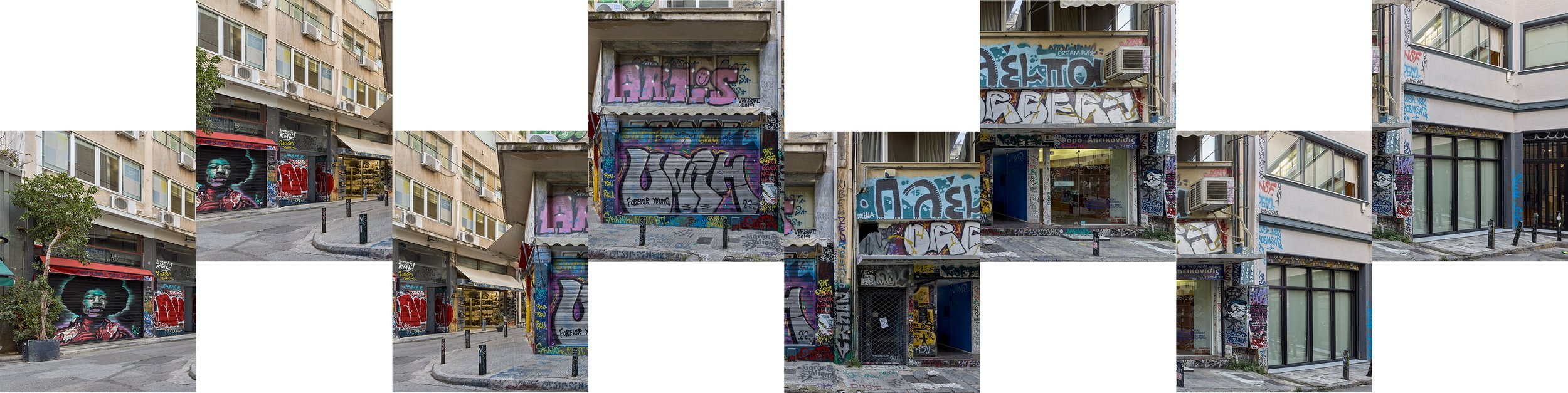
After uploading the AI outputs in Photoshop, each night plate was aligned with the daytime image. Using a combination of masks and adjustment layers, a continuous night image was then created from the AI plates. This night image was then layered above and blended with a manually created night from day image using older school techniques.
Although we utilize a series of prompts designed to keep the AI engine from changing any shapes in any one plate, minor details can become altered. This is most common in fonts and the placement of smaller objects like leaves. To ensure perfect registration for print, the image is scoured over and these imperfections are removed by overlaying/blending in cuts from the original photograph. Likewise, occasionally the AI engine creates something that makes no sense (such as the miniature bedroom above the retail store in the third image from right). These too needs to be edited out and often it is easier to blend in additional cuts from the daytime image to fix.
To finish, the image is finalized for print with additional adjustment layers to correct color/contrast for CMYK and added blur for depth of field simulation.
Copyright and Liability
As exciting as AI appears to be, there are warranted concerns about AI created content infringing upon already copyrighted material and/or being impossible to copyright itself. Given we are starting with an actual photograph we own the copyright to and using AI to help us generate a derivative work, this backing would not be infringing upon other intellectual property. Furthermore, since there are little to no physical alterations of objects within the derivative work along with human editing required to assemble the final night image, it is our professional opinion that this image is copyrightable. However, even if this night image is not deemed copyrightable, bare in mind when using a day|night backing, regardless of how that backing is lit, you are always recording the (copyrightable) daytime image with the nighttime image acting as a glorified color/luma filter.